

Very often we come across incidents of clients becoming unhappy with the reputed digital marketing agency they partnered with after poor results doused their big expectations despite the big name of the agency in the market.
So, are agencies themselves who wonder why their reputation of doing a somewhat magical job of elevating client websites into top ranks in SERP is no longer working as before?
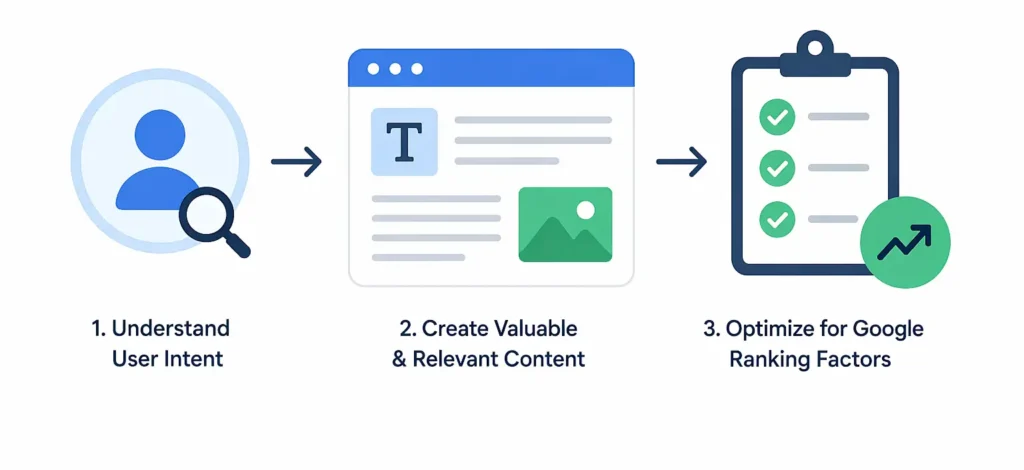
The main reason is user intent or search intent taking over search engine rankings after Google and others started prioritizing results that are most helpful to the users more than playing the game of keyword matching from the text.
The current search algorithms are built to comprehend context, user intent, and content quality. As a result, effective SEO content must balance user demands as well as search engine ranking signals.
Clearly, search has gone beyond ranking and is ensuring the user that he gets a trusted answer that satisfies the user’s underlying goal or search intent.
According to digital marketing experts, the expanding domain of user intent is all about aligning content with the user’s specific “why” as a critical determinant to ranking and traffic.
It is now known to all how Google algorithms like RankBrain, BERT, and MUM have mandated Google to interpret the intent behind the search queries. If the content of a website is very thin and does not satisfy the search intent, it will not rank high even despite high-volume keywords.
In other words, high search rankings grace those websites that deliver the best user experience (UX) in terms of high-quality content backed by relevant experience.
When a website diligently cares for user expectations, positive results are bound to follow in terms of lower bounce rates and higher dwell times as Google gets signals that the website is very authoritative.
Now look at the different types of user search intent. The top four are informational, navigational, commercial, and transactional. Let us take one example to illustrate this.
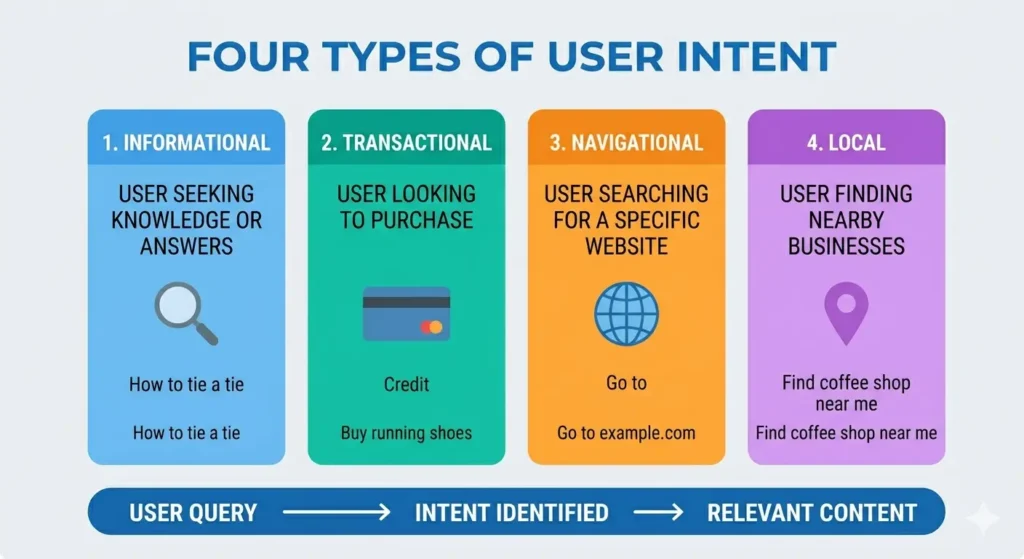
Example: A user searching for “best basketball shoes” will apparently be looking to compare products, and his intent is likely commercial. However, if a person is searching “buy Nike,” it means he is ready to make a purchase, and the user intent appears to be transactional. When content adequately matches search intent, it attracts qualified traffic that has maximum probability to convert.
As already noted, the purpose of a search query is referred to as user intent. When someone searches online, they typically want to find products, services, solutions, or information. For every query, search engines strive to provide the most pertinent and useful content. As a result, content that truly provides value and answers users’ questions has a much higher chance of ranking highly.
So, it becomes imperative on the part of anyone involved in digital marketing, blogging, or website management to understand the nuances of how to match content with user intent while satisfying important search ranking factors.
Recognizing User Intent
To understand what content works better to satisfy the user’s query search engines will analyze queries and scan the search intent that mainly fall into four categories.
Informational intent: Information-seeking users will seek clear answers to their queries.
Examples are:
· Why technical SEO is important?
· What is the key process of search engine optimization?
· What are the methods used for increasing website speed?
To answer the query the content must be rich with in-depth explanations, manuals, tutorials, and instructional materials.
Navigational intent: It involves e users trying to find a particular website or brand through navigational searches.
Examples include users looking up a specific company name.
• Searching for a particular product page
• Looking for a reputable website
In these situations, official websites or brand-related pages are given priority by search engines.
Transactional Intent: In this, users are ready for action, like buying or registering for a service.
Examples:
• Purchase of running shoes online
• Make hotel reservations
• Place an order for laptop accessories
To qualify for this intent, the website content must carry product information, pricing information, and simple conversion options.
Commercial Intent: Before making a purchase or choice, consumers conduct a commercial investigation about goods or services they want to buy.
Examples
• The best laptops for students
• 2026’s top digital cameras
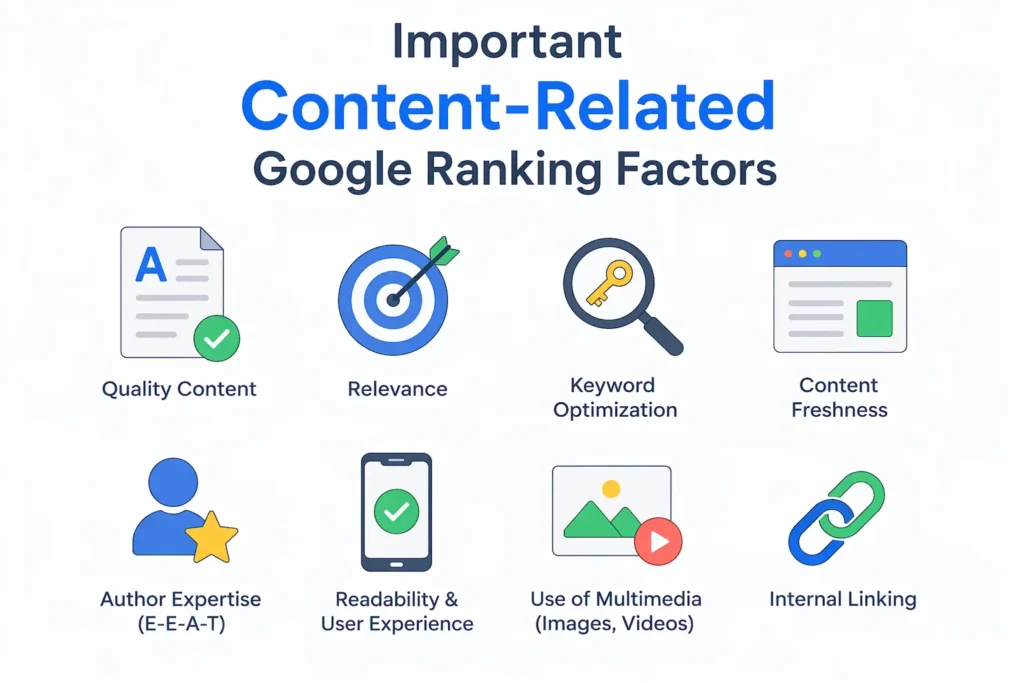
Although search algorithms take into account a variety of factors, a few crucial components have a direct impact on the ranking of content.
Quality of Content: Clear, accurate, and useful information is provided by high-quality content. It should be simple to read and comprehend while providing a thorough response to the user’s query.
The well-written content usually consists of
• Unambiguous structure
• A logical progression of concepts
• Applicable instances
• Trustworthy data
Search engines lap up content that exerts credibility and expertise.
Relevance: The content must also align with the user’s intent and the search query, and it will be organically incorporating pertinent keywords into headings, subheadings, and body text.
Freshness: The regularly updated content, complete with insightful analysis, often climbs the search rankings. Consistent updates signal to search engines that a site is active and reliable.
Experience of the user: User experience makes a significant impact on search performance. If a web page delivers a bad user experience even great content will not help in it giving it a top rank in the search results. Some of the important elements of the user experience are faster loading speed; mobile-friendly design and good navigation and impressive formatting.
